
client-go学习
简介
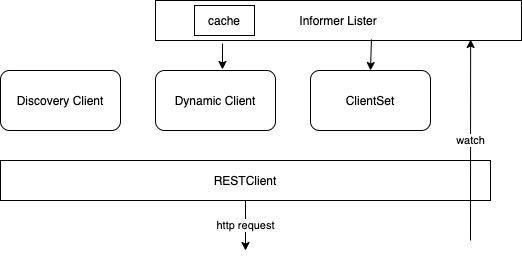
访问 k8s 集群获取资源有多种方式
- 命令行 kubectl
- http k8s REST API
- 代码库 client-go
- RESTClient ,其它客户端都是基于它实现的。
- ClientSet,在RESTClient的基础上封装了对Resource和Version的管理方法,即预先实现了每种Resource和Version的操作,因此只能够处理Kubernetes内置资源(即Client集合内的资源),要访问CRD需要通过client-gen代码生成器自动生成CRD操作相关的接口。
- Dynamic Client,用于处理Unstructured数据结构(即无法提前预知数据结构)
- informer
Kubernetes的client-go库介绍client-go是一个调用kubernetes集群资源对象http API的客户端(是一个典型的web服务客户端库),即通过client-go实现对kubernetes集群中资源对象(包括deployment、service、ingress、replicaSet、pod、namespace、node等)的增删改查等操作。
使用方式
包结构
k8s.io/client-go
    /rest           // 底层rest client 定义 RESTClient struct
    /kubernetes     // 访问 Kubernetes API的一系列的clientset
        /typed
            /core/v1
                /pod.go     // pod 相关api
            /extensions/v1beta1
                /deployment.go  // deployment 相关api
    /dynamic        // 对任意Kubernetes对象执行通用操作的动态client
        /dynamicinformer
        /dynamiclister
        /interface.go
    /informer
k8s.io/api
    /core/v1
        /types.go   // 定义了pod service 等struct
        /register.go
RESTClient
RESTClient是所有客户端的父类,底层调用了Go语言net\http库,访问API Server的RESTful接口。以查询pod 为例
// 从本机加载kubeconfig配置文件,因此第一个参数为空字符串
config, err := clientcmd.BuildConfigFromFlags("", *kubeconfig)
config.APIPath = "api"
config.GroupVersion =  &corev1.SchemeGroupVersion  // schema.GroupVersion{Group: GroupName, Version: "v1"}
// 指定序列化工具
config.NegotiatedSerializer = scheme.Codecs
// 根据配置信息构建restClient实例
restClient, err := rest.RESTClientFor(config)
// 保存pod结果的数据结构实例
result := &corev1.PodList{}
// GET请求
err = restClient.Get().
	// 指定namespace,参考path : /api/v1/namespaces/{namespace}/pods
	Namespace(namespace).
	// 查找多个pod,参考path : /api/v1/namespaces/{namespace}/pods
	Resource("pods").
	// 指定大小限制和序列化工具
	VersionedParams(&metav1.ListOptions{Limit:100}, scheme.ParameterCodec).
	// 请求
	Do(context.TODO()).
	// 结果存入result
	Into(result)
ClientSet 方式
Clientset是所有Group、Version组成的客户端集合,每个GV客户端底层由RestClient实现。但ClientSet只能处理pod、deployment等事先已确定好GVR的Kubernetes内置资源。自定义的CR无法提前知道其GV信息和数据结构,无法使用ClientSet进行处理。
类似于 /core/v1 和 /extensions/v1beta1 这些GroupVersion 在 k8s.io/client-go 和 k8s.io/api 都有对应目录。
config,err := clientcmd.BuildConfigFromFlags("",kubeconfig)
clientset, err := kubernetes.NewForConfig(config)
pod,err := clientset
    .CoreV1()       // 选择APIGroupVersion 即 /api/v1
    .Pods("book")   // 命名空间
    .Get("example",metav1.GetOptions{}) // 访问 /api/v1/namespaces/book/pods/example
以node resource 为例,展示使用client-go 对 resource 进行查询和更新
clientset, err := kubernetes.NewForConfig(config)
// 获取node 列表
nodes, err := clientset.CoreV1().Nodes().List(context.TODO(), metav1.ListOptions{})
// 更新
_, err = a.client.CoreV1().Nodes().Update(context.TODO(), newNode, metav1.UpdateOptions{})
// 发送patch 指令更新
patchTemplate := map[string]interface{}{
		"metadata": map[string]interface{}{
			"labels": map[string]interface{}{
				labelkey: labelvaule,
			},
		},
	}
patchdata, _ := json.Marshal(patchTemplate)
_, err := clientset.CoreV1().Nodes().Patch(ctx, Nodes[i].Name, types.StrategicMergePatchType, patchdata, metav1.PatchOptions{})
给pod 添加label,有时直接Update 容器revision conflict
labelPatch := fmt.Sprintf(`[{"op":"add","path":"/metadata/labels/%s","value":"%s" }]`, "labelkey", "labelvaule")
_, err = sc.kubeClient.CoreV1().Pods(p.Namespace).Patch(context.TODO(), p.Name, types.JSONPatchType, []byte(labelPatch), metav1.PatchOptions{})
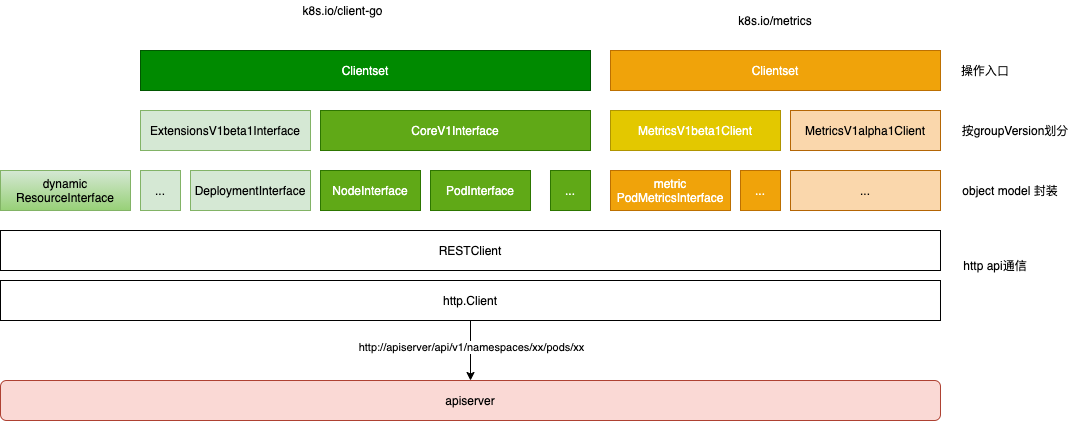
从上到下来说:Clientset是调用Kubernetes资源对象最常用的client,可以操作所有的资源对象。需要指定Group、Version,然后根据Resource获取 对应的XXInterface。
pod /node 等API Resource 按GroupVersion(CoreV1/ExtensionsV1beta1) 进行了聚合,对外提供CoreV1Client/ExtensionsV1beta1Client,各个GroupVersion Interface 聚合为 clientset
type CoreV1Interface interface {
	RESTClient() rest.Interface
	ConfigMapsGetter
	EventsGetter
	NamespacesGetter
	NodesGetter
	PersistentVolumesGetter
	PersistentVolumeClaimsGetter
	PodsGetter
	PodTemplatesGetter
	ReplicationControllersGetter
	SecretsGetter
	ServicesGetter
	...
}
type CoreV1Client struct {
	restClient rest.Interface   // 通用的REST 客户端
}
以pod 为例,对外提供了 PodInterface 封装了对Pod 的api。 Pod 的schema 数据 k8s.io/api 对应GroupVesion 路径下的 register.go 文件中 注册到 统一的 Schema 中,schema 数据在client-go 中用于 http 数据的解封装。
// k8s.io/client-go/deprecated/typed/core/v1/pod.go
type PodInterface interface {
	Create(*v1.Pod) (*v1.Pod, error)
	Update(*v1.Pod) (*v1.Pod, error)
	Delete(name string, options *metav1.DeleteOptions) error
	Get(name string, options metav1.GetOptions) (*v1.Pod, error)
	List(opts metav1.ListOptions) (*v1.PodList, error)
	Watch(opts metav1.ListOptions) (watch.Interface, error)
	Patch(name string, pt types.PatchType, data []byte, subresources ...string) (result *v1.Pod, err error)
	...
}
// pods implements PodInterface
type pods struct {
	client rest.Interface
	ns     string
}
// k8s.io/client-go/rest/client.go
type RESTClient struct {
    base *url.URL
    Client *http.Client
    ...
}
func (c *pods) Get(name string, options metav1.GetOptions) (result *v1.Pod, err error) {
	result = &v1.Pod{}
	err = c.client.Get().       // 新建Request 对象
		Namespace(c.ns).        // 设置Request.namespace
		Resource("pods").       // 设置Request.resource
		Name(name).             // 设置Request.resourceName
		VersionedParams(&options, scheme.ParameterCodec).
		Do(context.TODO()).     // 执行Request.request
		Into(result)
	return
}
client-go 包含了 k8s 一些核心对象的访问,此外一些非核心对象 或用户crd 对象可以独立提供类似 client-go 功能
- 比如metric 机制相关的 PodMetrics/NodeMetrics对象,其代码都在
k8s.io/metrics包里。 - controller-runtime 为cr 生成对应的client,scheme中 包含了cr 的信息。
informer 方式
“高冷”的 Kubernetes Informer 一探究竟为了让 Client-go 更快地返回 List/Get 请求的结果、减少对 Kubenetes API 的直接调用,Informer 被设计实现为一个依赖(并且只依赖) Kubernetes List/Watch API 、可监听事件并触发回调函数的二级缓存工具包。PS:这点zk/etcd 等client 也提供类似本地缓存能力,只是zk/etcd client 存储的是通用数据,没有封装资源对象。
Informer是一个带有本地缓存和索引机制的、可以注册 EventHandler 的 client,本地缓存被称为 Store,索引被称为 Index。使用 informer 的目的是为了减轻 apiserver 数据交互的压力而抽象出来的一个 cache 层, 客户端对 apiserver 数据的 “读取” 和 “监听” 操作都通过本地 informer 进行(相对于直接监听apiserverresp, err := http.Get("http://apiserver:8080/api/v1/watch/pods?watch=yes"))。Informer 实例的Lister()方法可以直接查找缓存在本地内存中的数据。
// Informer 工厂
factory := informers.NewSharedInformerFactory(clientset, 30*time.Second)
// Informer 工厂  Core().V1().Nodes() 方法时,返回的是 PodeInformer 接口。
// PS: 用了这么久,才知道工厂返回实例还有这么玩的
nodeInformer := factory.Core().V1().Nodes()
go nodeInformer.Informer().Run(stopCh)
if !cache.WaitForCacheSync(stopCh, nodeInformer.Informer().HasSynced) {
    runtime.HandleError(fmt.Errorf("Timed out waiting for caches to sync"))
    return
}
nodes, err := nodeInformer.Lister().List(labels.NewSelector())
Dynamic client
如果一个 controller 中需要控制所有的 API,可以使用dynamic client,目前它在 garbage collector 和 namespace controller中被使用。
k8s.io/client-go
    /dynamic
        /dynamicinformer
        /dynamiclister
        /interface.go
Dynamic client 是一种动态的 client,它能处理 kubernetes 所有的资源。不同于 clientset,dynamic client 对GVK 一无所知, 返回的对象unstructured.Unstructured(在k8s.io/apimachinery 中定义,并注册到了schema 中),本质是一个 map[string]interface{}。
type Object interface {
	GetObjectKind() schema.ObjectKind
	DeepCopyObject() Object
}
type Unstructured interface {
	Object
}
type Unstructured struct {
 	// Object is a JSON compatible map with string, float, int, bool, []interface{}, or map[string]interface{} children.
 	Object map[string]interface{}
}
func (obj *Unstructured) GetObjectKind() schema.ObjectKind { return obj }
func (u *Unstructured) GetAPIVersion() string {...}
func (u *Unstructured) GetNamespace() string {...}
func (u *Unstructured) GetName() string {...}
func (u *Unstructured) GetOwnerReferences() []metav1.OwnerReference {...}
func (u *Unstructured) MarshalJSON() ([]byte, error) {
	var buf bytes.Buffer
	err := UnstructuredJSONScheme.Encode(u, &buf)
	return buf.Bytes(), err
}
func (u *Unstructured) UnmarshalJSON(b []byte) error {
	_, _, err := UnstructuredJSONScheme.Decode(b, nil, u)
	return err
}
Unstructured 虽然不是具体的资源类型,但是获取 TypeMeta 这些基本信息还是可以的。Unstructed和具体资源类型如Pod直接的转化由runtime.unstructuredConverter的FromUnstructured和ToUnstructured方法分别实现。
dynamicClient, err := dynamic.NewForConfig(config)
gvr := schema.GroupVersionResource{Version: "v1", Resource: "pods"}
// 返回非结构化的对象
unstructObj, err := dynamicClient.Resource(gvr).Namespace("sandbox").List(context.TODO(), metav1.ListOptions{Limit: 40})
podList := corev1.PodList{}
// 额外做一次类型转换,如果这里传错类型,就会有类型安全的风险
err = runtime.DefaultUnstructuredConverter.FromUnstructured(unstructObj.UnstructuredContent(), podList)
相比底层的 RESTClient,基于 unstructured.Unstructured 实现了 数据的解封装 及watch 机制。
// k8s.io/client-go/dynamic/interface.go
type ResourceInterface interface {
	Create(ctx context.Context, obj *unstructured.Unstructured, options metav1.CreateOptions, subresources ...string) (*unstructured.Unstructured, error)
	Update(ctx context.Context, obj *unstructured.Unstructured, options metav1.UpdateOptions, subresources ...string) (*unstructured.Unstructured, error)
	Delete(ctx context.Context, name string, options metav1.DeleteOptions, subresources ...string) error
	Get(ctx context.Context, name string, options metav1.GetOptions, subresources ...string) (*unstructured.Unstructured, error)
	List(ctx context.Context, opts metav1.ListOptions) (*unstructured.UnstructuredList, error)
	Watch(ctx context.Context, opts metav1.ListOptions) (watch.Interface, error)
    ...
}
// k8s.io/client-go/dynamic/simple.go
func (c *dynamicResourceClient) Get(ctx context.Context, name string, opts metav1.GetOptions, subresources ...string) (*unstructured.Unstructured, error) {
    // 这里直接拼接了 api resource 的请求路径
	result := c.client.client.Get().AbsPath(append(c.makeURLSegments(name), subresources...)...).SpecificallyVersionedParams(&opts, dynamicParameterCodec, versionV1).Do(ctx)
	retBytes, err := result.Raw()
	uncastObj, err := runtime.Decode(unstructured.UnstructuredJSONScheme, retBytes)
	return uncastObj.(*unstructured.Unstructured), nil
}
其它
首先说client之前,必须要先初始化一个config结构。
// k8s.io/client-go@v0.19.11/tools/clientcmd/client_config.go
func BuildConfigFromFlags(masterUrl, kubeconfigPath string) (*restclient.Config, error) {
	if kubeconfigPath == "" && masterUrl == "" {
		klog.Warningf("Neither --kubeconfig nor --master was specified.  Using the inClusterConfig.  This might not work.")
		kubeconfig, err := restclient.InClusterConfig()
		if err == nil {
			return kubeconfig, nil
		}
		klog.Warning("error creating inClusterConfig, falling back to default config: ", err)
	}
	return NewNonInteractiveDeferredLoadingClientConfig(
		&ClientConfigLoadingRules{ExplicitPath: kubeconfigPath},
		&ConfigOverrides{ClusterInfo: clientcmdapi.Cluster{Server: masterUrl}}).ClientConfig()
}
- 如果在外部集群,可以读取kubeconfig作为配置(默认为
~/.kube/config); - 如果运行在集群中,可以采用serviceaccount 的方式,client-go从
/var/run/secrets/kubernetes.io/serviceaccount/token和/var/run/secrets/kubernetes.io/serviceaccount/ca.crt读取文件,对应InClusterConfig
client-go 定义了一个 ClientConfig interface,包含DeferredLoadingClientConfig/DirectClientConfig/InClusterConfig 实现。 clientcmd.BuildConfigFromFlags(masterUrl,kubeconfigPath)读取k8s config 是有搜索顺序的,如果masterUrl/kubeconfigPath 都为空,则会返回InClusterConfig,否则返回DeferredLoadingClientConfig。
更新status
更新status,以Deployment 为例,/apis/apps/v1beta1/namespaces/${ns}/deployments/${name} 只能更新deployment 的 spec。/apis/apps/v1beta1/namespaces/${ns}/deployments/${name}/status 只能更新 deployment 的status。
留下评论